French Foreign Legion
Man on FireThe French Foreign Legion is both a fighting force and a refuge for people with nowhere else to belong. In Guido Arrellio’s account, its modern equipment, uncompromising discipline, and repeated use in desperate campaigns are only part of its character: it also creates its own purpose and community from men who have been cut off from their national homes. That combination shapes the friendship between Guido and Creasy, and remains a point of return even after their military lives have carried them far from the Legion.
Recruitment, training, and composition
Guido joined the French Foreign Legion in Marseilles in 1955 and served for six years. When he enlisted, he had no papers, spoke only Italian, and had little money; he imagined he might desert after a year or two and return to Naples. Instead, the Legion became a much longer education. The initial weeks were hard, its discipline implacable, and disobedience could mean the punishment battalion or, for lesser offenses, the stockade. Guido learned to obey, becoming a model recruit—an outcome that would have surprised people who knew him in Naples.
The institution also contradicted his romantic idea of an old-fashioned desert army. Its food was varied and excellent, with good wine from its own vineyards, and its equipment and techniques were highly modern. Its officers were described as the cream of the French army; its noncommissioned officers had risen from the ranks and brought experience from battlefields around the world. The ranks gathered men of varied national and political backgrounds: Germans whose collective memory began after 1945, East Europeans unwilling or unable to return behind the Iron Curtain, Spaniards who might have been remnants of the Civil War, and smaller numbers of Dutch, Scandinavian, Belgian, English, and American recruits. French citizens were not accepted as Legionnaires, except as officers.
The six-month training period changed Guido physically as well as professionally. His short, thickset body filled out through hard work and good food, and he discovered physical capacities he had not known he possessed. He took pride in his fitness. Socially, however, he remained taciturn and self-contained. The only Italian in his intake, struggling to learn French, he felt isolated and made no friends among the recruits. When a large, aggressive Dutchman tested whether he could be pushed around, Guido retaliated savagely. The instructors permitted the fight, treating such confrontations as a way to learn who could withstand pressure; afterward, they left him alone and judged that he might become a good Legionnaire.
A force shaped by war
The Legion’s institutional history is marked by campaigns in which it is sent when ordinary measures have failed. In the account given to Guido’s young listener, it is rebuilding after the disastrous end of the Vietnam campaign and the Battle of Dien Bien Phu, where several thousand Legionnaires were captured and more than fifteen hundred killed. Its role as a last resort made it expendable to a government struggling to relinquish an empire. The implication is not that the Legion lacks military capability, but that its repeated service in lost or desperate battles can make purpose and morale seem precarious.
The Legion counters that precarity through an identity not founded on the nationalism of its members. It generates a corporate purpose of its own: its members fight for the Legion, while service to French government policy is incidental. Even French officers can feel their loyalty drawn more strongly toward the corps than toward their country. French civilians, by contrast, mistakenly imagine that Legionnaires fight for France and think of themselves as French. The distance between that public assumption and the Legion’s inward allegiance helps explain why it is depicted as a distinct community rather than simply an instrument of the state.
Its relationship with France becomes especially tense during the Algerian War. As opposition to de Gaulle’s anticipated political settlement intensified, white settlers erected barricades in Algiers. Many professional soldiers sympathized with them, particularly the airborne units that had borne the brunt of the fighting. The gendarmes were ordered to clear the barricades, with two para units, including the Legion’s 1st R.E.P., sent in support. Both units dragged their feet, and the gendarmes suffered many dead and wounded. After the regiment’s mutiny, Guido recalled that the Legion had expected at one point to parachute onto Paris and arrest de Gaulle. The prospect horrified the French public; with more than thirty thousand men, the Legion could have posed a threat to France itself had it acted as a whole. In the aftermath, the bulk of the Legion was based in Corsica and other locations outside mainland France.
Guido and Creasy in the ranks
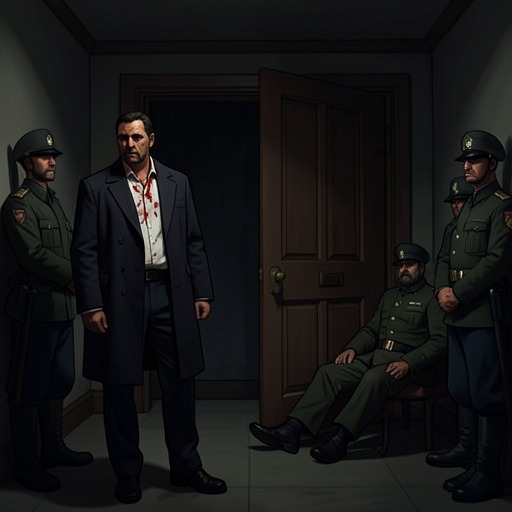
After training, Guido volunteered for the elite 1st R.E.P., based at Zeralda, west of Algiers, as the Algerian War escalated. Assigned to B Company, he served under Creasy, an American sergeant returning to active service after nine months as a prisoner of war at Dien Bien Phu. Their bond was not immediate. Guido was an untested recruit; Creasy was a decorated veteran and senior noncommissioned officer. Both, however, were private, introspective men who shunned ordinary contact, and their understanding developed in the close, difficult environment of military life.
Their first substantial conversation followed an action near Palestro. After the Algerian National Liberation Front ambushed a patrol of French conscripts, killing many, the Legion pursued the attackers. B Company was dropped to cut off their escape, and Guido saw combat for the first time. Initially confused by the noise and movement, he settled into the action and used his light machine gun effectively; the opposing unit was wiped out. In another operation, when the Legion was dropped behind a retreating force that escaped, Creasy again chose to sit beside Guido at the evening meal. Their conversation turned to weapons. Creasy told him that carrying a pistol and four spare clips wasted weight: a pistol was useful only when concealment mattered, while a submachine gun was better suited to close combat. He advised Guido to carry additional magazines instead.
Guido accepted the advice and chose Creasy as his model. By the beginning of the Battle of Algiers in January 1957, he had made his mark and become a Legionnaire first class; a year later he was a noncommissioned officer. As his knowledge grew, their conversations shifted from instruction toward exchanges between equals. Their friendship formed gradually, with few words and long silences that neither found strained. The two were repeatedly assigned together as the fighting intensified, becoming a formidable partnership known throughout the Legion. Creasy’s reputation had already reached Guido through the story of Colonel Bigeard calling him the most effective soldier he had ever seen after watching him retake a position at Dien Bien Phu.
Beyond the Legion and the possibility of return
The Legion’s distinctive provision for aging members gives substance to its role as a refuge. Guido discovered that it did not force soldiers to retire. When too old to fight, a Legionnaire could remain in the Legion home, work in the vineyards, or take up work in its handicraft center. A man who had rejected the world beyond the corps would not be compelled to re-enter it simply because he could no longer serve in combat. The Legion thus functions, in Guido’s understanding, as a permanent home for people who have become psychological outsiders.
Creasy’s later return to Corsica tests whether that home still exists for him. In Rhodesia, the recurring futility of war brings his earlier campaigns into focus; he loses interest, drinks heavily, and grows lethargic. Removed from operations and made an adviser, he recognizes that his continued place is being granted out of gratitude for his earlier service. Pride takes him away. After a failed attempt to find a woman he once knew in Brussels, he travels to Marseilles and impulsively takes the ferry to Corsica, where the Legion’s main contingent is based. Years after the 1st R.E.P.’s mutiny, the Legion itself has forgiven. The possibility that the former outsider might return to his old community draws him uphill toward the barracks.
In Calvi, Creasy sits in the square and hears recruits marching to the Legion’s hymn, Le Boudin. Their measured pace and smart new uniforms make the institution’s continuity visible, but the young faces also sharpen his sense of age: he feels a thousand years old. He does not go to the barracks. After finishing his drink, he walks to the station; the following day, in Bastia, he waits at the docks for the ferry to Livorno and considers visiting Guido. The Legion has offered a home that does not compel return, and Creasy’s departure leaves open whether friendship might make a different future possible.
The Legion’s continuing reach
The Legion’s influence persists in the lives and connections of former members. Guido invokes his Legion service when Creasy asks about his connections, remarking that he has never told him how he came to join; the irony of that history is deferred while they turn to practical planning. Elsewhere, Guido recognizes Verrua as an old Legion acquaintance from the 2nd R.E.P. Verrua had completed two hitches, left as he grew older, and spent ten years doing strong-arm work for Cantarella in Sicily before being put out to pasture. Living in Naples with his married daughter, he often visited the pension and reminisced about Creasy and their early days in Vietnam. Disenchanted with Cantarella because he felt he had not been properly looked after, he talked about the Villa Colacci and its security arrangements. Guido’s knowledge of the Legion’s old network thereby becomes useful in the present, though Verrua’s information reaches them through grievance and reminiscence rather than formal service.
The organization’s meaning also reverberates beyond its campaigns and veteran networks. Its language of orphanhood makes sense against Creasy’s own childhood: after his mother died of pneumonia without adequate medical care, his father died a year later, and Creasy was taken in by neighbors before running away and joining the Marines. Much later, Pinta gives him a gold crucifix, a gift connected to their conversation about his troubled relation to Catholic faith. The Legion does not resolve that history, but its promise that a rejected man need not be forced out of the community he has chosen offers a powerful counter-image to abandonment. Across Guido’s disciplined service, the comradeship he builds with Creasy, and Creasy’s hesitant return toward Corsica, the Legion is presented as both an instrument of war and an enduring answer to the question of where the displaced can belong.